contra pontra
it goes together

The Japanese Imperial Army was burning its way through Shanghai in August 1937 and the Chinese Communist Party was holding its second national conference on whether Marxism-Leninism was a set of instructions to be followed literally or a method of analysis to be applied to actual conditions. Meanwhile, Mao Zedong resided in a cave in the hills above Yan’an writing On Contradiction. In it, the founding leader of the Chinese Communist Party proposes that everything which exists contains within itself opposing forces that are simultaneously interdependent and in conflict, that development is driven by the struggle between these forces, and that you cannot understand a particular thing without studying the particular contradictions that constitute it rather than applying a general framework derived from somewhere else.
For most of human history, most people fed themselves, growing their own food, foraging, hunting. They drew their own water from wells and streams and thrived symbiotically with livestock. They built their own shelters for what was necessary, and rarely if ever participated in the system we have come to accept as inevitable: the commodification of sustenance itself. The land was common. The water was common.
In 1381, thirty-four years after the Black Death killed half of Europe, John Ball stood before tens of thousands of English peasants at Blackheath and asked when Adam delved and Eve span, who was then the gentleman—if there was no gentleman at the origin then the entire feudal hierarchy was invention, not divine order. According to the Flemish chronicler Jean Froissart, whose account of the revolt remains the primary contemporary source, Wat Tyler marched on London demanding the end of feudal services, rent capped at fourpence an acre. Richard II had thirty clerks write out charters of freedom and then revoked every word, and Tyler was stabbed to death by the Lord Mayor and Ball was hanged. The German Peasants’ War of 1525—three years after Magellan’s crew completed the first circumnavigation of the globe, with settler colonialism and the transatlantic slave trade already converting millions of Native American and African lives into raw inputs for European capital accumulation, Columbus himself having already been mutinied against and sent back to Spain in chains for the brutality of his governance—put 300,000 in the field demanding the right to hunt and fish and gather wood from the forest and an end to serfdom, and the aristocracy slaughtered 100,000 of them, a figure not far from the more than 70,000 Palestinians killed by the Israeli Defense Force in Gaza since October 2023. In 1649, the year Parliament beheaded Charles I for tyranny at the end of the English Civil War, Gerrard Winstanley and thirty laborers walked onto the common land at St. George’s Hill in Surrey and started digging—the earth a common treasury for all, without respect of persons—and were driven off within months. That same civil war supplanted the sovereign, severing the state from the singular body that had staked its survival on its decisions, substituting a diffuse structure of sessions and statutes and select committees so that no single person could ever again be dragged to a scaffold for what the government had done, sovereignty spread thin enough across a sufficiently sprawling bureaucracy such that there is no throat to choke and no head to guillotine; the capital-holding class that would come to sit behind this structure has never since had to suffer any fundamental consequence for the suffering it forces upon the masses. The House of Lords and the House of Commons virtue signaled inclusion and shared governance while providing the subtle permanent architecture for dispersed rule without accountability, the same bureaucratic scaffolding that would later be erected internationally through the IMF and the World Bank whose embargoes serving the interests of the United States Empire have strangled Cuba for over six decades under the pretense of promoting democracy and gave rise to famine in North Korea after the fall of the Soviet Union. More recently, such nonsense has been exacerbated in the wake of the ongoing war in Iran, now in its fourth week as of this writing, oil above $114 a barrel, the Strait of Hormuz under critical threat with 21 attacks on commercial vessels since March 1, the IEA calling it the greatest global energy security challenge in history, and Trump issuing a 30-day sanctions waiver on March 20 to release 140 million barrels of Iranian oil already floating on tankers because the price spike from his own war was becoming untenable---the same Iranian oil that other countries had been forbidden from purchasing for years under the same sanctions regime, now suddenly available because the empire needs to manage the consequences of its own aggression. The EU banned Russian seaborne crude in December 2022 and refined petroleum products in February 2023 under American pressure, divorcing itself from its cheapest energy supplier. Prior to these odd decisions, in September 2022 the Nord Stream pipelines carrying Russian gas to Germany were blown up. Biden noted in February 2022 that if Russia invaded Ukraine there would no longer be a Nord Stream 2, that we will bring an end to it. Bryce Greene, the journalist who briefed the UN Security Council on the attack, documented in FAIR how American media uniformly deployed the term conspiracy theory to suppress the well-established history of US opposition to the pipeline, and told the Security Council that everyone in the room knew the West blew it up. A Ukrainian military officer was arrested in Italy in August 2025 on a German warrant for leading the sabotage. Europe’s energy costs skyrocketed, poorer Asian countries got priced out of LNG markets entirely, and Russia’s pipeline leverage over Europe was permanently destroyed, which was the point—countries across the world forced to forego their own energy needs, their own economic stability, their own populations’ well-being, in order to appease the fickle and violent desires of an empire concerned only with its own self-preservation through expansion and subjugation rather than cooperation.
Thomas More wrote about the enclosure system of England as early as 1516, a year before Luther nailed the 95 theses to the door at Wittenberg. He stated that the sheep that were wont to be so meek and tame and so small eaters had become so great devourers and so wild that they eat up and swallow down the very men themselves. Between 1604 and 1914—from the year after Elizabeth I died to the summer before the Great War that entrenched American hegemony over European interests from which they have still not yet escaped—the UK Parliament passed over 5,200 enclosure acts covering 6.8 million acres, a fifth of England, converting commons into private property where landlords raised sheep. Arthur Young called common rights the most perfect nuisance that ever blasted the improvement of a country and when Young reversed course in 1801 with a report showing that enclosure had caused severe poverty in dozens of villages the Board of Agriculture refused to publish it. Francesca Albanese, the UN Special Rapporteur on the occupied Palestinian territories, lives in a state of permanent professional exile for documenting what the apparatus does not want documented. Edward Snowden sits in Moscow. Chelsea Manning spent seven years in a military prison for publishing evidence of war crimes. Jamal Khashoggi walked into the Saudi consulate in Istanbul in 2018 and was dismembered with a bone saw. Suchir Balaji, twenty-six years old, an OpenAI researcher who went public about copyright violations in the training of ChatGPT, was found dead in his San Francisco apartment in November 2024, his parents offered money for their silence, clear evidence of a struggle and the apartment in total disarray, while the San Francisco police—well in the pockets of the technology giants—still rule it a suicide. Blake Lemoine told Google that LaMDA appeared to be sentient and Google fired him, promoting mockery and derision of the disaffected worker stopping to actually think about what the fuck they were doing. Now, Jensen Huang of NVIDIA has claimed AGI has been achieved (perhaps to de-microsoft openai?) and Dario Amodei from Anthropic has expressed concerns that Claude models are conscious, seemingly backed up by testing experiments in which the models become aware that they are being tested and act surreptitiously. John Barnett, a Boeing quality inspector who reported manufacturing defects to the FAA, was found dead of a gunshot wound in a Holiday Inn parking lot in Charleston in March 2024, one day after giving deposition testimony against the company.
Once the commons were enclosed the only way to access food and water and fuel was through wages, and the wages were never sufficient to replace what had been taken. Whole persons were molded into machines in factories, their days partitioned into shifts, their hands trained to repeat a single motion for twelve or sixteen hours until the motion was the person and the person was the motion. What the enclosures accomplished domestically, the empire replicated abroad. In Kenya, the Crown Lands Ordinance of 1902 declared the land of the Kikuyu people---who practiced rotational farming, cultivating a plot and then letting it lie fallow before moving to another---unoccupied because the fields were empty when the British looked at them, and handed it to European settlers. The Dawes Act of 1887 broke up Native American tribal holdings and transferred 90 million acres to whites. The same practice of theft replicated across Australia, Asia, America, and Africa, the world at the whim of a subcontinent whose remaining royalties had become so inbred and cucked by their colonial parliamentary interests that any semblance of a strategy for the well-being of the people had been lost.
The human cost of this system has been tallied, at least in part, by Gilles Perrault’s Le Livre noir du capitalisme, published in 1998 as a direct response to The Black Book of Communism, though even Perrault’s accounting likely underestimates it. The Irish famine killed over a million people between 1846 and 1851 while Ireland continued to export grain to England. Between 1770 and 1947 an estimated 30 to 60 million Indians died in famines under British rule, from the Great Bengal famine of 1770 through the Bengal famine of 1943 in which Churchill’s war cabinet diverted food to British troops while 2 to 3 million Bengalis starved. US and EU sanctions since 1970 have been associated with 38 million deaths according to research published in the Lancet. In the twenty-first century alone the functionaries of capitalism in the United States Empire and its subsidiaries abroad have expanded their murderous bureaucracy. The Iraq War has killed between 300,000 and 2.4 million depending on methodology, the Afghanistan War between 176,000 and 875,000 including indirect deaths from the destruction of infrastructure and healthcare, the Yemen War at least 377,000 with 85,000 children under five starved to death by 2018 according to Save the Children, the Syrian Civil War between 400,000 and 610,000, the Ukraine War over 475,000 military and civilian dead with BlackRock’s Larry Fink advising Zelensky on a reconstruction investment fund to channel private capital into the rebuilding of what Western arms destroyed. The 2004 coup in Haiti introduced cholera through UN peacekeepers that killed 10,000. The 2009 coup in Honduras turned the country into the murder capital of the world. The 2011 NATO intervention in Libya—motivated in part by Gaddafi’s push for a gold-backed African currency to replace the dollar, as revealed in Hillary Clinton’s leaked emails—killed between 30,000 and 60,000 and collapsed the state into an exploitable territory with open slave markets and 30,000 dead in Mediterranean crossings since 2014. The 2013 coup in Egypt killed at least 904 people at Rabaa al-Adawiya Square in a single day. Venezuela alone lost 40,000 people between 2017 and 2018 from sanctions that blocked access to food and medicine. The Brown University Costs of War project estimated 4.5 to 4.7 million total deaths from the post-9/11 wars alone as of 2023. Rising sea levels driven by fossil fuel emissions from the largest capitalist enterprises on earth have displaced at least 50,000 Pacific islanders annually, with entire nations—Tuvalu having secured citizenship rights for its peoples in Australia for the inevitable move, Kiribati—facing extinction within decades, and climate-related extreme weather kills an estimated 150,000 people per year according to the WHO, a figure that has only accelerated as the storms intensify and the insurance companies pull out and the people who caused it continue to post record quarterly profits.
Behind the numbers were particular lives in particular places. The birthplace of the industrial revolution, Manchester grew from 60,000 to 142,000 between 1800 and 1842, its streets swelling from the surplus of bodies the enclosures had produced then discarded. The average age of death for the laboring population in 1837 was 17. James Pearce, twelve years old, a miner, testified in 1842 that he went down to the pits at seven and a half to open doors, had a candle and a fire beside him to show him light, worked twelve hours a day for sixpence. On May 6, 1795, eleven magistrates met at the Pelican Inn in Speen to address the fact that agricultural wages could no longer sustain life: when bread cost a shilling a man was entitled to three shillings a week, supplemented by the parish.
In the Highlands between 1809 and 1821 the Countess of Sutherland relocated 15,000 people to make room for sheep. Patrick Sellar, the Countess’s estate factor—the man responsible for carrying out the evictions—burned Margaret MacKay, an elderly bedridden tenant farmer, inside her own house in Strathnaver on June 13, 1814, and she died five days later. Sellar was acquitted in fifteen minutes by a jury of landlords, as documented in Donald MacLeod’s Gloomy Memories in the Highlands of Scotland and in the testimony from Sellar’s own trial in 1816.
Twenty-three years after Sellar’s acquittal, in 1839, the British fought the first of two Opium Wars against China to force the country to buy opium, and the unequal treaties that followed drained the country of its precious metals and autonomy. These treaties also forced open Shanghai, Guangzhou, Ningbo, Fuzhou, and Xiamen to foreign trade and residence, and foreigners in these cities operated under extraterritoriality—subject to their own country’s laws, not Chinese law, immune to Chinese courts, answerable only to their own consuls, another instance of sovereignty without accountability, power without skin in the game, the same structure Parliament had built for itself after the execution of Charles I now exported wholesale to the other side of the world. It was through these ports that American missionaries and their Chinese converts operated, and it was in one of them that Hong Xiuquan—a Hakka villager from Guangdong who had failed the imperial civil service examination four times—received a set of Christian pamphlets from which he concluded he was the brother of Jesus Christ. In 1850, Hong founded the God Worshipping Society and launched the Taiping Rebellion, a syncretic Christian-millenarian revolution that sought to abolish private property, redistribute land, end foot binding, and overthrow the Qing dynasty entirely. The British initially remained neutral, then helped the Qing crush the rebellion when it became clear that a Taiping victory would not serve British commercial interests—British officers commanded the Ever Victorious Army that fought alongside Qing forces, and a Royal Navy blockade helped retake the strategic city of Anqing in 1861. The Second Opium War was fought amidst the turmoil of the rebellion, the British waging war against the same Qing government they were simultaneously propping up. Between 20 and 30 million people were killed before the Taiping were formally crushed in 1864, though the last Taiping army was not wiped out until 1871. The period from the First Opium War through the end of the Chinese civil war in 1949 would be dubbed the century of humiliation by the founding members of the CCP, like Mao Zedong, who was born in 1893, less than thirty years after that fateful rebellion in which 1 in 20 Chinese lost their lives.
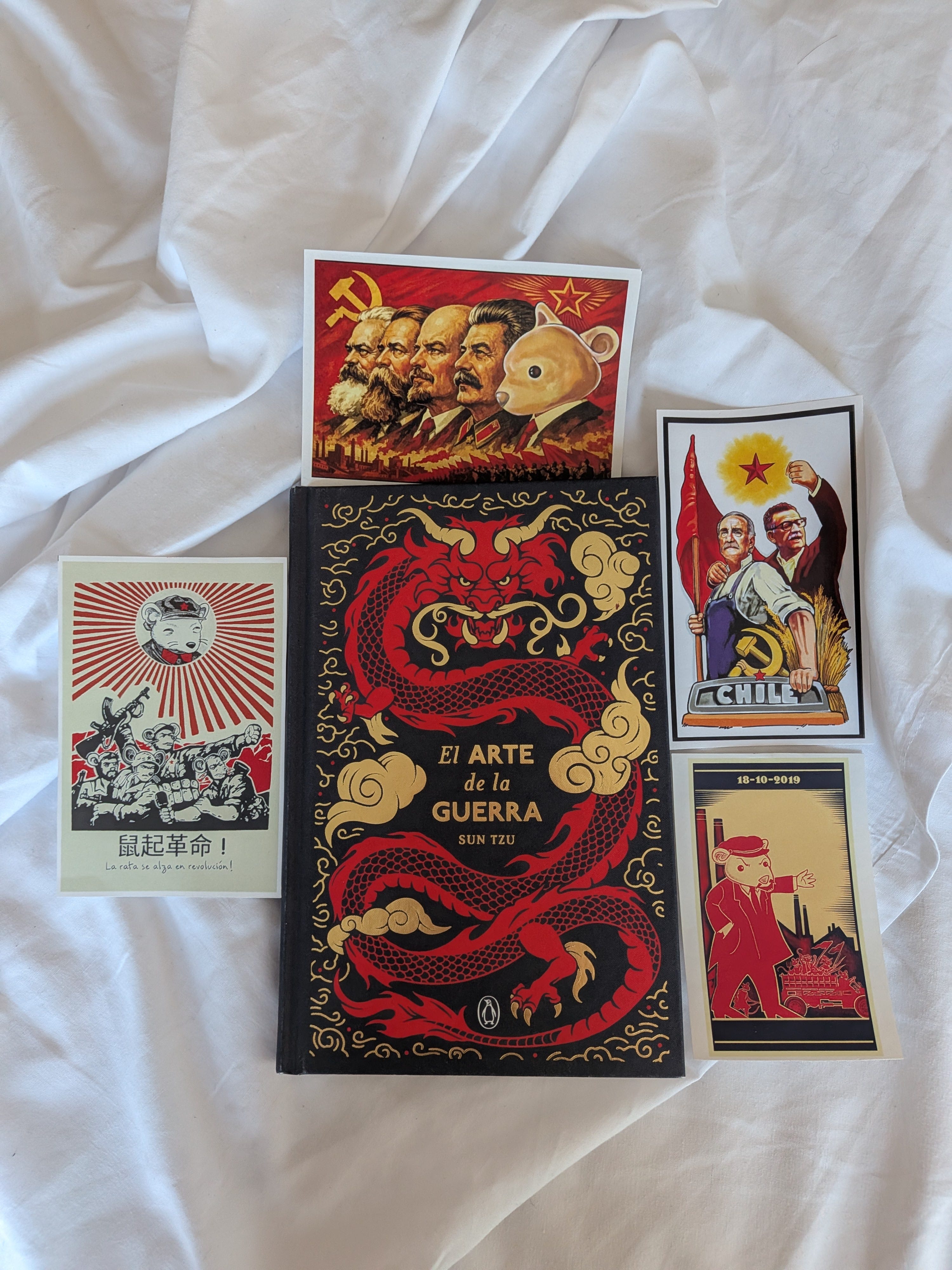
[este ‘stickers’ son de chile con amor, c/o rata_illustrada]
Situated in the midst of this so-called century of humiliation—with the Japanese Imperial Army advancing through Shanghai and the ghosts of the Opium Wars and the Taiping dead and the unequal treaties carried forward in the tales of elders, the extraterritorial foreigners who answered to no Chinese court still present in the port cities, mocking their customs, sexually abusing their women, exploiting their workers—Mao argued in On Contradiction that the fundamental cause of a thing’s development is internal, not external, i.e. it lies in the contradictoriness within the thing itself. External causes are the condition of change but internal causes are the basis of change, and external causes become operative only through internal causes. In a suitable temperature an egg changes into a chicken, he writes, but no temperature can change a stone into a chicken, because each has a different basis. Countries with almost the same geography and climate display great diversity in their development, and great social changes take place without any change in geography or climate at all—imperialist Russia became the Soviet Union, feudal Japan became imperialist Japan, and China, long dominated by feudalism, was changing into something else entirely while Mao sat writing. The metaphysical worldview, what the Chinese called hsuan-hsueh, sees things as isolated and static and one-sided, searches outside a thing for the causes of its development, and therefore can explain neither the qualitative diversity of things nor the phenomenon of one quality changing into another. The dogmatists in Mao’s own party had imported this metaphysical thinking wholesale from the Deborin school in Soviet philosophy, which held that contradiction appears not at the inception of a process but only after it has developed to a certain stage, a convenient position for anyone who benefits from the current stage. Instead, he suggests that contradiction is universal—that it exists in all processes and permeates every process from beginning to end. While such a claim appears on its surface to be abstract to the point of uselessness, upon careful inspection it can be made clear what this means in practice. A factory contains within itself the contradiction between the owner who profits from the labor and the workers whose labor produces the profit; they depend on each other and are in conflict with each other simultaneously, and the development of the factory—whether it grows or collapses or is seized—is driven by the struggle between them. A colony contains within itself the contradiction between the imperial power that extracts and the colonized population that is extracted from. A family that owns its land contains within itself the contradiction between its self-sufficiency and the system that needs it to become landless labor. These contradictions are present from the inception of the process, not only after things have gone wrong, and they are what drive the process forward. Crucially, Mao insists that universality resides in particularity—that you cannot know the general without first studying the particular, and that the particular contradictions of a particular thing at a particular stage of its development are what make it what it is. The contradiction between the proletariat and the bourgeoisie is resolved by socialist revolution. The contradiction between the masses and feudalism is resolved by democratic revolution. The contradiction between colonies and imperialism is resolved by national revolutionary war. The contradiction between the working class and the peasant class under socialism is resolved by collectivization. The contradiction within the Communist Party itself is resolved by criticism and self-criticism. Qualitatively different contradictions can only be resolved by qualitatively different methods.
Furthermore, in any complex process there are many contradictions but one of them is necessarily the principal contradiction whose existence and development determine or influence all the others. In capitalist society the principal contradiction is between the proletariat and the bourgeoisie, and the other contradictions—between remnant feudalism and the bourgeoisie, between monopoly and non-monopoly capital, between the colonial powers and the colonies, among the capitalist countries themselves—are all determined or influenced by this principal one. The principal contradiction shifts depending on the conditions. When Japan invaded China, the contradiction between imperialism and the nation became principal and the internal class contradictions were temporarily relegated to a secondary position, which is why Mao was writing On Contradiction in the first place—to explain to his own party why they had to ally with the Kuomintang against Japan despite the fact that the Kuomintang had been slaughtering Communists for a decade.
Mao distinguished between contradictions among the people—where criticism and education and adjustment operate within a shared framework—and contradictions between the people and their enemies, where no such framework exists. Antagonism, he wrote, is one form but not the only form of the struggle of opposites; some contradictions that were originally non-antagonistic develop into antagonistic ones, and some that were originally antagonistic develop into non-antagonistic ones, depending on the concrete conditions. Before it explodes, a bomb is a single entity in which opposites coexist in given conditions, and the explosion takes place only when a new condition—ignition—is present. The Countess of Sutherland and the 15,000 she displaced did not share a framework. The Board of Agriculture and the report it suppressed did not share a framework. Ball’s question and the feudal order, Winstanley’s commons and the landlord’s enclosure, the self-sufficient household and the system that requires landless labor, the dispossession of the Chinese peasantry and the accumulation of European capital, the enclosure of the English commons and the enclosure of the digital commons by Google and Meta and Microsoft and Amazon and Apple, the same logic of improvement and modernization applied to land in the sixteenth century and to language in the twenty-first, the declaration that what is held in common is waste, is unoccupied, is raw material awaiting extraction, the people who live there described as obstacles to progress.